
Link to:
Significant Dates | History | Survivor Recollections | Chronology of Site Use | Author | Notes | Photos & Coordinates | See Also | Sources
The former Portage la Prairie Indian Residential School is located in Treaty 1 territory, at the Keeshkeemaquah village on Long Plain Reserve No. 6. This land was granted to Long Plain First Nation as part of an outstanding treaty land entitlement in 1981. [1] It is located on the traditional territory of the Ojibway, Dakota, Cree, and Anishinaabe people, and forms part of the homeland of the Red River Métis. [2]
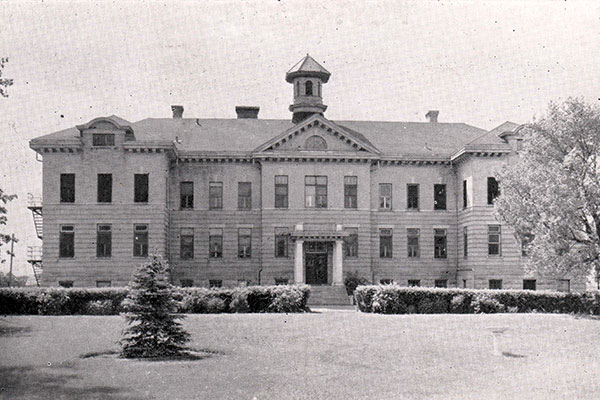
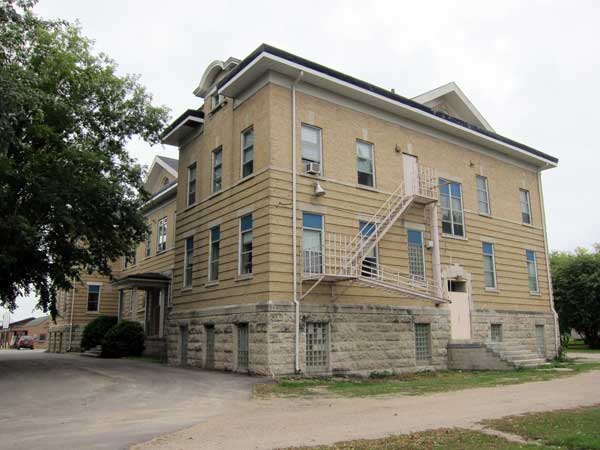
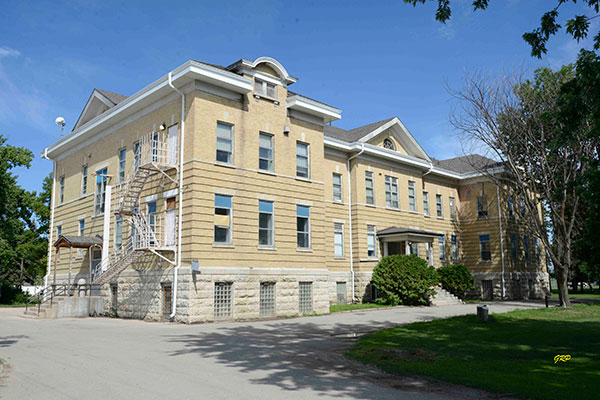
This two-storey brick and stone building on Crescent Road West in Portage la Prairie, designed by Department of Indian Affairs architect Jean Dosithe Chene [3], was constructed in 1914 by the Brown Construction Company of Winnipeg. [4] It was occupied from 1915 to 1975 by the Portage la Prairie Indian Residential School. Also known as the Portage la Prairie Indian Boarding School, Portage Indian Student Residence, Yelloquill College, and Rufus Prince Building, it is now used as a resource centre by the Long Plain First Nation. The main floor provides a home for the National Indigenous Residential School Museum of Canada.
Date(s)
Event
1914
Construction of the school at this location began, funded by the federal government and administered by the Home Mission Board of the Presbyterian Church
April 1915
Classes began in the new building
1925-1926
The school administration was taken over by the United Church of Canada, following church union
1965
The school became Portage Indian Student Residence, with all students attending local schools
1969
Administration of the residence was taken over by the federal government
30 June 1975
Residence closed
14 August 1981
Land was granted to Long Plain First Nation as part of an outstanding treaty land entitlement
1 October 1984
Building opened as Yellowquill College, run by the Dakota Ojibway Tribal Council
2000
The building was converted to office space and renamed for Rufus Prince after Yellowquill College moved to Winnipeg [5]
12 April 2005
Designated as a Provincial Heritage Site with a plaque erected by the Manitoba Heritage Council
April 2018
Gained charity status with a Board of Directors
September 2020
Designated as a National Historic Site by the Historic Sites and Monuments Board of Canada
The former Portage la Prairie Indian Residential School at Crescent Road was at least the third building occupied by the school. [6] The school was founded in 1886 by local women from Knox Presbyterian Church. It began as a day school for Dakota people living just outside Portage la Prairie in what was known as Sioux Village. During the first year, the women provided clothing and food to Dakota students from the ages of about 10 to 40. [7] Christian education was the women’s main concern, and it is not clear what other lessons were included. [8] In about 1887, the school was taken over by the Women’s Foreign Mission Society of the Presbyterian Church, and it became a boarding school for First Nations children. It was incorporated into a growing system of residential schools run by Christian churches on behalf of the Canadian government. The school grew over the years, and more pupils from nearby reserves, such as Long Plain, were added to the student body. Construction of the Crescent Road location began in 1914 to accommodate this growth. The building was designed by Jean Dosithe Chene, the architect for the Department of Indian Affairs. Construction was completed by the Brown Construction Company of Winnipeg. [9] Classes were officially moved to the new building in April 1915. [10]
The residential school system in Canada has been called a “cultural genocide” by the Truth and Reconciliation Commission of Canada because it separated Indigenous children from their families, communities, cultures, and languages in an effort to make them like white Canadians, often inflicting lasting trauma in the process. [11] Research since 2015 has provided evidence that the residential school system was only one part of a larger process of genocide against Indigenous peoples, which took place through many colonial systems, and even continues in the present day. [12] The history of Portage la Prairie Indian Residential School includes many features common to residential schools across the country. Children typically had their hair cut upon arrival and were issued new clothing. They were forced to speak English instead of their own languages and punished if they did not. Their daily lives were controlled by a strict schedule and rules. Religious education was a large part of the student experience, since the school was managed by the Presbyterian, and later the United Church.
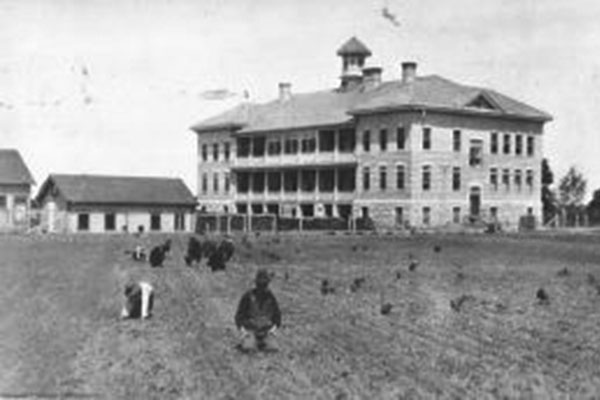
After the move to the Crescent Road location, farming became a primary activity for male students and staff. The property included 56 acres of farmland (later increased to 177 acres), which was supposed to teach the children a useful trade. [13] Much student labour was required to keep up with the farm work. The school began using the half-day system, where students were in class for half the day and worked for the other half. Male students did farm work, and female students were taught domestic skills, such as cooking, cleaning, and sewing.
Survivors recall loneliness for their families and abuse from staff and fellow students during their time at the school. Some students resisted their treatment, including by running away. This could result in humiliating and abusive punishments when they were caught and returned to the school. For instance, former Long Plain Chief Dennis Meeches recalls that his mother and some of her friends were caught running away from the school. The matron punished them by cutting their hair and putting paper bags over their heads, later pulling the bags off in the dining hall to publicly humiliate them. [14] Other issues included poor nutrition and outbreaks of illness, including rubella and influenza, which spread in crowded dormitories. [15]
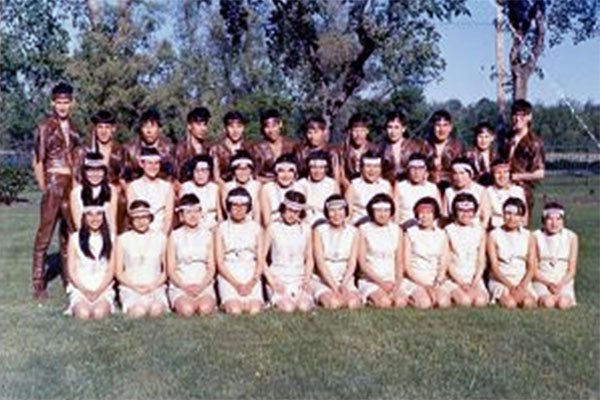
In the late 1950s and early 1960s, the school transitioned to become Portage Indian Student Residence. During these years, Indigenous children lived at the residence or at private homes in the community while attending public high school in Portage la Prairie. Students came from further away, including many northern communities. The residence was known for its Glee Club, an auditioned choir that toured to promote the school. [16] The choir performed at Expo 67 in Montreal, and even toured to Japan. [17] During these years, Principal J. O. Harris began a program to allow students to earn extra spending money by working in the local community. Many students worked at local Portage la Prairie businesses on Saturdays and during vacations. [18] While some student memories from these years are positive, including participation in sports and recreational activities, integration into the public system came with challenges. Student “dropouts” were common during these years, and some students commented on the intimidation they felt when approaching public school teachers for extra help. [19] Others felt discouraged and dropped out because they felt that their friends were too far ahead of them. [20] Student life continued to involve strict rules, as outlined in the student manuals of the era. [21]
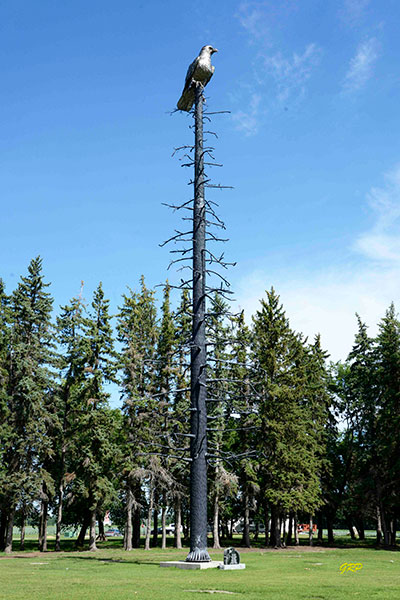
The residence was managed directly by the federal government after 1969, and it closed in 1975. [22] In 1981, the building and some of the surrounding land were granted to Long Plain First Nation as part of a treaty land entitlement claim. Though the school had been a site of trauma for many in the community, the First Nation chose to keep the building to commemorate what had happened. The building has had a variety of uses since then. From 1984 to 2000, Yellowquill College, run by the Dakota Ojibway Tribal Council, occupied the building. The college later moved to Winnipeg. [23] Currently, the building houses the offices of Long Plain First Nation and the National Indigenous Residential School Museum of Canada. It is now called the Rufus Prince Building, after a former student who fought in the Second World War and was later a Chief of Long Plain First Nation. [24] A monument of a Golden Eagle, by artist Jake Goertzen, was erected at the site in 2007 to honour those who attended residential schools. [25]
The school building was designated as a Manitoba Provincial Heritage Site in 2005, and in 2020, it was designated a National Historic Site of Canada, recognizing its connections to the residential school system. [26] Since then, Parks Canada has been working with the National Indigenous Residential School Museum on various efforts to commemorate the school, including a YouTube video featuring former chiefs Dennis Meeches and Ernie Daniels from Long Plain First Nation. [27]
In 1986 and 1998, the United Church of Canada issued apologies for its role in Canadian colonization and the residential school system. [28] The Church now works to commemorate the schools and tell the truth about what happened. It hosts a website called The Children Remembered, which includes a page about Portage la Prairie, along with a selection of historic photos.
The former Portage la Prairie Indian Residential School is one of the few former residential schools left standing. It is a typical example of residential schools across the country, which harmed generations of Indigenous children. However, it is also an example of the unique local context of this system in Portage la Prairie. It was connected to the community from the very early years, when it was founded by local church women and this connection continued in later years when children boarded in private homes and worked in local businesses. The building’s current role as the National Indigenous Residential School Museum of Canada gives it ongoing importance in teaching others about residential schools.
Grace Daniels: “We used to call the Residential School a jail. That was the term we used when we talked about the Institution, it was a jail to us. For me it was ten years spent in jail...We had to live and abide by strict rules and regulations, which were imposed and enforced by the Principal. I wondered why Native people had to live that way. I didn’t understand. When I left the Residential School that’s when I realized the truth. I had to change my way of thinking because I didn’t know anything about the outside world. To me, it was like an outside world because I was institutionalized and isolated in that same place for ten years.” [29]
Grace Daniels: “I found the most difficult experience for us was not seeing our parents during the ten months we were there. Just the odd time we would get to visit our parents. When we did see them, it was a big treat for us. We were always happy to see everybody else’s parents come to the institution for a visit too. The children who came from far away communities such as Swan Lake and Roseau River were the ones who rarely saw their parents during the time they were at the Portage Residential School. It must have been hard for parents to travel in those days because most of the traveling was done by horse and buggy then. It wasn’t so bad for the students who lived close by like Long Plain and Sioux Village, now Dakota Tipi. They’re the ones who would get to see their parents more often than the ones that lived far away.” [30]
Max Merrick: “I say that the school destroyed everything. That’s where it began. That’s why our children are the way they are today. We were never taught the right way to raise our children properly, because we were deprived of our parenting skills. Which deeply affected our ability to parent our own. When I came out of that system, I began a family. I tried teaching them the way I was taught in school. It didn’t work, it didn’t work at all.” [31]
Ernie Daniels: “We were happy children growing up. Then somebody comes along from government, takes us away, puts us in a place of confinement, containment. I almost call it a glorified concentration camp. Which I call cultural genocide myself. To assimilate us, to get rid of our… the spirit of an Indian in us, to get rid of our languages, get rid of our culture, our ceremonies, our lodges, which we had a very strong attachment to. And we were tortured. We were physically, sexually, and emotionally, and psychologically abused. Because they thought our language, our ceremonies were evil. Their language was more or less destroyed by this process. We had a number of our children, our people right now, they don't have a clue about their language. That's kind of a testament of what happened.” [32]
Owner
Role(s)
Dates
Government of Canada (Department of Indian Affairs), managed by the Presbyterian Church in Canada
Portage la Prairie Indian Residential School
1914-1925
Government of Canada; managed by the United Church of Canada
1925-1965
Portage Indian Student Residence
1965-1969
Government of Canada
1969-1975
Vacant
1975-1981
Long Plain First Nation [33]
Vacant?
1981-1984
Yellowquill College
1984-2000
Office space
2000-present
National Indigenous Residential School Museum of Canada
2018-present*
* Lorraine Daniels, Executive Director, NIRSM: The National Indigenous Residential School Museum Inc. was first registered as the Indian Residential School Museum Inc. in September 2005. The early phase of the project consisted of a research team who gathered information and started a collection of archives. The Museum was registered as NIRSM Inc. in April 2018, and has remained consistently open since December 2018.
APTN News, Tour the National Indigenous Residential School Museum with Survivor Lorraine Daniels
Jennifer Wood, Survivor Testimony, Where are the Children?, Legacy of Hope Foundation
National Indigenous Residential School Museum of Canada, History: The Former Portage la Prairie Indian Residential School
National Centre for Truth and Reconciliation, Digital archival collection, Portage la Prairie Indian Residential School
National Centre for Truth and Reconciliation, Portage la Prairie Residential School Narrative
Parks Canada, Former Portage la Prairie Indian Residential School National Historic Site
United Church of Canada, “Portage la Prairie Residential School,” The Children Remembered
Emma Hutchinson was born and raised in Camrose, Alberta, on Treaty 6 territory. She received her BA in History from The King’s University in Edmonton in 2023 and spent time working in heritage administration following her graduation. Currently, she is a student in the Archival Studies stream of the University of Manitoba/University of Winnipeg Joint Master’s Program in History, where her research interests include the ethics of archival work relating to records of institutionalized children.
The above text was produced as part of a collaborative public history project between students in the Department of History and Joint Masters History Program at the University of Winnipeg, the Southern s’ Organization, and the Manitoba Historical Society. Honours and Masters students researched and wrote digital public history articles that align with the Southern Chiefs’ Organization 25th Anniversary History Project and contribute to the expansion of Indigenous history content on the Manitoba Historical Society website. Course: Commemorating Indigenous Histories, HIST-4614/GHIST-7513, Winter 2025, Instructor: Dr. Erin Millions.
Thank you to Lorraine Daniels, Executive Director, NIRSM, for providing feedback on this article.
1. National Indigenous Residential School Museum of Canada, “History: The Former Portage la Prairie Indian Residential School,” accessed February 25, 2025.
2. Portage la Prairie School Division, “Indigenous Education Guiding Principles,” [n.d.], 4.
3. Superintendent-General of Indian Affairs, “Indian Boarding School Portage la Prairie - Accepce. Tender The Brown Construction Co. Wpg. $66,225 - S. G. I. A.,” 11 June 1914, Library and Archives Canada, RG2, Privy Council Office, Series A-1-a, Item ID 311625.
4. Allison Sarkar, Lorraine Daniels, and Barb Esau, with Patricia Myran, Ruth Roulette, and Dennis Meeches, “The Former Portage la Prairie Indian Residential School, Portage la Prairie, Manitoba,” Historic Sites and Monuments Board of Canada Submission Report, 2019-24, 2.
5. Sarkar et al., “Former Portage la Prairie Indian Residential School,” 3.
6. Samuel Crothers Murray, “Historical Sketch of the Portage la Prairie Indian School and Mission,” 1936, 75, 112, United Church of Canada Archives (Manitoba, Northwestern Ontario and All Native Circle Conference), PP60, 3345.
7. Amanda Norris MacKay, “Notes on the Early History of the Indian Residential School Portage la Prairie,” [n.d.], 5, United Church of Canada Archives (Manitoba, Northwestern Ontario and All Native Circle Conference), PP90, 3282, folder A.
8. MacKay, “Notes on the Early History,” 4-5.
9. Sarkar et al., “Former Portage la Prairie Indian Residential School,” 3.
10. Murray, “Historical Sketch,” 109-110, 112.
11. Truth and Reconciliation Commission of Canada, A Knock on the Door: The Essential History of Residential Schools from the Truth and Reconciliation Commission of Canada, edited and abridged, with a foreword by Phil Fontaine (University of Manitoba Press, 2016), 3.
12. National Inquiry into Missing and Murdered Indigenous Women and Girls, “A Legal Analysis of Genocide,” supplementary report to Final Report, 2019.
13. Murray, “Historical Sketch,” 110, 122; John S. Milloy, A National Crime: The Canadian Government and the Residential School System, 1879 to 1986, with a foreword by Mary Jane Logan McCallum (University of Manitoba Press, 2017; originally published in 1999), 35.
14. Parks Canada and National Indigenous Residential School Museum of Canada (NIRSM), “Maamiikwendan Portage la Prairie Residential School,” 18 September 2024, 2:55-3:42.
15. Sarkar et al., “Former Portage la Prairie Indian Residential School,” 31.
16. United Church of Canada, “Portage la Prairie Residential School,” The Children Remembered, accessed 28 February 2025.
17. APTN News, “Tour the National Indigenous Residential School Museum with Survivor Lorraine Daniels,” 1 October 2024.
18. J. O. Harris to E. E. M. Joblin, April 17, 1963, in “Portage Residential School – Correspondence, 1956-65,” United Church of Canada Archives (Manitoba, Northwestern Ontario and All Native Circle Conference), 509/2/2-10, no. 7.
19. Anonymous to J. O. Harris, December 13, 1964, in [Student Letters Regarding Dropouts], in “Churches in Indian Communities,” United Church of Canada Archives (Manitoba, Northwestern Ontario and All Native Circle Conference), Records of the Conference Home Missions Committee, 509/1/3-1-23, c58 d70.
20. Anonymous to [J. O. Harris], ca. 1964, in [Student Letters Regarding Dropouts].
21. “Students Manual: Portage la Prairie Indian Residential School,” [n.d.], authorized by J. O. Harris, in “Portage Residential School – Correspondence, 1966-68,” United Church of Canada Archives (Manitoba, Northwestern Ontario and All Native Circle Conference), 509/2/2-10, no. 8.
22. “Portage la Prairie Residential School Narrative,” 2.
23. “History,” Yellowquill University College, accessed March 7, 2025; Sarkar et al., “Former Portage la Prairie Indian Residential School,” 2.
24. Greg Thomas, “Former Portage la Prairie Indian Residential School Designated a National Historic Site,” Prairie History no. 3 (2020): 86.
25. Carling Beninger, “Implementing TRC Call to Action #79: Commemoration of Indian Residential School Sites,” ActiveHistory.ca, 30 September 2017.
26. Province of Manitoba, Historic Resources Branch, “Manitoba Provincial Heritage Site No. 119: Portage la Prairie Indian Residential School (Rufus Prince Building), River Lot 51, Crescent Road, Portage la Prairie,” accessed 26 February 2025; Parks Canada, “Former Portage La Prairie Indian Residential School National Historic Site,” accessed 25 February 2025.
27. Parks Canada and NIRSM, “Maamiikwendan”; Parks Canada, “Former Portage la Prairie Indian Residential School.”
28. “The Apologies,” United Church of Canada, accessed 30 April 2025.
29. Grace Daniels, quoted in Sarkar et al., “Former Portage la Prairie Indian Residential School,” 26.
30. Grace Daniels, quoted in Sarkar et al., “Former Portage la Prairie Indian Residential School,” 35.
31. Max Merrick, quoted in Sarkar et al., “Former Portage la Prairie Indian Residential School,” 37.
32. Ernie Daniels, quoted in Parks Canada and NIRSM, “Maamiikwendan,” 3:48-4:57.
33. Long Plain First Nation acquired 45 acres outside of Portage la Prairie, including the buildings and site of the former Portage la Prairie Indian Residential School, as Treaty Land Entitlement in 1981. This is now Keeshkeemaquah Reserve.
Children in the planting fields at Portage Indian Residental School (circa 1930s)
Source: United Church of Canada Archives, 1993.049P/1752
The Portage Indian Residental School Glee Club (1967)
Source: United Church of Canada Archives, 1986.158P/31
Postcard view of Portage Indian Residental School (no date)
Source: Gordon Goldsborough, 2012-0056
Former Portage la Prairie Indian Residential School building (September 2011)
Source: Gordon Goldsborough
Former Portage la Prairie Indian Residential School building (July 2020)
Source: George Penner
Southeast corner of the former Portage la Prairie Indian Residential School building (June 2025)
Source: Gordon Goldsborough
Northeast corner of the former Portage la Prairie Indian Residential School building (June 2025)
Source: Gordon Goldsborough
Commemorative plaque at the former Portage la Prairie Indian Residential School building (June 2025)
Source: Gordon Goldsborough
Closeup of commemorative plaque (June 2025)
Source: Gordon Goldsborough
Golden eagle monument at the former Portage la Prairie Indian Residential School (July 2020)
Source: George PennerSite Coordinates (lat/long): N49.96230, W98.32255
denoted by symbol on the map above
Manitoba Business: Brown Construction Company
Historic Sites of Manitoba: Staff of the Portage la Prairie Indian Residential School
Historic Sites of Manitoba: Brandon Indian Residential School (RM of Cornwallis)
Historic Sites of Manitoba: Brandon Indian Residential School Cemetery (RM of Cornwallis)
Historic Sites of Manitoba: Brandon Old Indian Residential School Cemetery (Brandon)
Historic Sites of Manitoba: Birtle Indian Residential School (Birtle, Municipality of Prairie View)
Historic Sites of Manitoba: Elkhorn Indian Residential School (Elkhorn, RM of Wallace-Woodworth)
Historic Sites of Manitoba: Clearwater Lake Indian Hospital / Guy Hill Indian Residential School (Northern Manitoba)
Historic Sites of Manitoba: MacKay Indian Residential School (Opaskwayak Cree Nation)
Historic Sites of Manitoba: Norway House Indian Residential School (Norway School)
Historic Sites of Manitoba: Pine Creek Indian Residential School / Camperville Indian Residential School (Pine Creek First Nation)
Historic Sites of Manitoba: Portage la Prairie Indian Residential School (Crescent Road West, Portage la Prairie)
Historic Sites of Manitoba: Julia Clark School (611 Academy Road, Winnipeg)
Historic Sites of Manitoba: Residential School Totem Pole (Assiniboine Park, Winnipeg)
Historic Sites of Manitoba: Rupert’s Land Indian Industrial School / St. Paul’s Industrial School (Middlechurch, RM of West St. Paul)
Historic Sites of Manitoba: Portage Indian Boarding School (Ninth Street NE, Portage la Prairie)
Historic Sites of Manitoba: Provincially Designated Historic Sites
Historic Sites of Manitoba: Manitoba Plaques for Persons, Events and Sites of National Historic Significance
Portage la Prairie Indian Residential School (Rufus Prince Building), Manitoba Historic Resources Branch.
The MHS thanks Katherine Nichols, Diane Haglund, Nathan Kramer, Judy Gleich, and George Penner for providing additional information used here.
This page was prepared by Gordon Goldsborough.
Page revised: 26 February 2026
Historic Sites of Manitoba
This is a collection of historic sites in Manitoba compiled by the Manitoba Historical Society. The information is offered for historical interest only.
Browse lists of:
Museums/Archives | Buildings | Monuments | Cemeteries | Locations | OtherInclusion in this collection does not confer special status or protection. Official heritage designation may only come from municipal, provincial, or federal governments. Some sites are on private property and permission to visit must be secured from the owner.
Site information is provided by the Manitoba Historical Society as a free public service only for non-commercial purposes.
Send corrections and additions to this page
to the MHS Webmaster at webmaster@mhs.mb.ca.Help us keep history alive!