Link to:
Principals | Vice-Principals | Teachers | Photos & Coordinates | Sources
Established in Winkler, within the Garden Valley School Division, the Garden Valley Collegiate Institute (GVCI; the word Institute was later removed from its name) was formed by the amalgamation of the Plum Coulee Collegiate and Winkler Collegiate on 1 September 1966. Construction of this facility began with a sod-turning ceremony on 19 August 1966. The structure was based on architectural designs of Norman Earl Reimer and was opened to students on 1 September 1967, with an official unveiling ceremony on 10 December 1967.
Period
Principal
?-1967
1967-1968
Henry Neufeld
1968-1994
?
1994-2003
Karl Gerhard Redekop (1949-2025)
Period
Vice-Principal
1967-1971
Frank Brown (1906-2002)
Period
Teachers
?-1967
1967-1968
Frank Brown (grade 11), David Vincent Brown (grade 9), Ronald Wayne “Ron” Busse (no grade), Margaret Evelyn Carley (no grade), Robert John Cooney (grade 10), Viola M. Doell (no grade), Edward Peter “Ed” Falk (grade 10), Otto David Funk (no grade), Henry Wayne Hiebert (grade 12), Abe Edwin Hildebrand (grade 10), Gerhard A. Hildebrand (grade 9), Carol Lorraine Johnston (grade 10), Tina Kehler (grade 12), Patricia Anne Kolisnyk (grade 11), Harvey Ronald Kroeker (grade 9), Bernhard “Bernie” Loeppky (grade 11), Peter Nickel (grade 9), Jacob Pauls (grade 9), George David Pries (grade 10), Lloyd Allen Rietze (grade 12), Daniel Walter “Dan” Sawatzky (grade 10), William Schroeder (grades 11-12), John Frank Wiebe (grade 11)
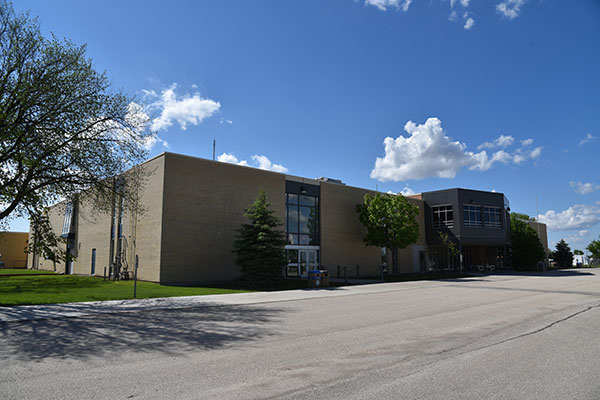
Garden Valley Collegiate (June 2020)
Source: Gordon Goldsborough
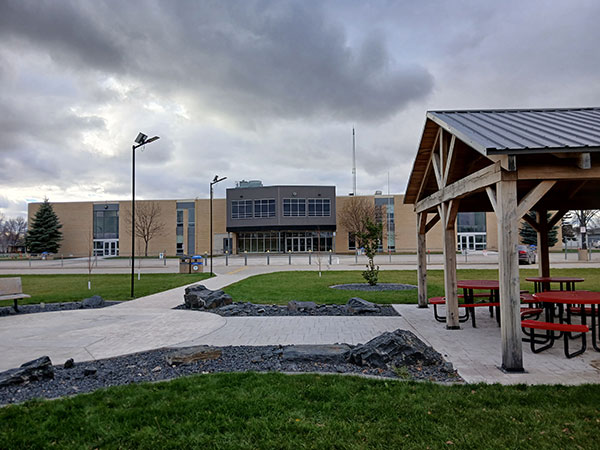
Garden Valley Collegiate (November 2025)
Source: Rose KuzinaSite Coordinates (lat/long): N49.18965, W97.94096
denoted by symbol on the map above
See also:
Memorable Manitobans: Norman Earl Reimer (1927-1981)
Historic Sites of Manitoba: Winkler School No. 747 / Winkler Collegiate (Winkler)
Annual Reports of the Manitoba Department of Education, Manitoba Legislative Library.
“Tender notice [Garden Valley Collegiate Institute],” Winnipeg Free Press, 1 June 1966, page 46.
“School bylaw defeated,” Winnipeg Free Press, 28 June 1965, page 22.
“Tender notice,” Winnipeg Free Press, 3 June 1966, page 26.
School division half-yearly attendance reports (E 0757), Archives of Manitoba.
Manitoba School Records Collection, Winkler School No. 747 Daily Registers, GR2656, Archives of Manitoba.
Manitoba School Records Collection, Winkler School (Special Education) No. 747 Daily Registers, GR2656, Archives of Manitoba.
A History of Winkler, 1892-1973, by Frank Brown, 1973.
One Hundred Years in the History of the Rural Schools of Manitoba: Their Formation, Reorganization and Dissolution (1871-1971) by Mary B. Perfect, MEd thesis, University of Manitoba, April 1978.
We thank Gordon Goldsborough and Rose Kuzina for providing additional information used here.
This page was prepared by Nathan Kramer.
Page revised: 11 November 2025
Historic Sites of Manitoba
This is a collection of historic sites in Manitoba compiled by the Manitoba Historical Society. The information is offered for historical interest only.
Browse lists of:
Museums/Archives | Buildings | Monuments | Cemeteries | Locations | OtherInclusion in this collection does not confer special status or protection. Official heritage designation may only come from municipal, provincial, or federal governments. Some sites are on private property and permission to visit must be secured from the owner.
Site information is provided by the Manitoba Historical Society as a free public service only for non-commercial purposes.
Send corrections and additions to this page
to the MHS Webmaster at webmaster@mhs.mb.ca.Help us keep history alive!